Five essays asked what happened to the restaurant. This one asks what gets built instead. A few operators have written the answer. Almost nobody else can reach it.
By Johnny AuerMay 202616 min read
She has been in the kitchen since six this morning. The room was a bookstore last year. No hood. No black iron. No gas line. No grease trap. No exhaust shaft. No Type I permit. No six-month code review. No two-hundred-thousand-dollar build-out. She picked the space first. The menu came after. Tonight it opens as a ramen counter. Fourteen seats. Two cooks. One server.
She is forty-one, ran a Michelin one-star in the city for three years, and walked away with a list of decisions she would never make again. The hood she financed for thirty thousand dollars. The walk-in she filled three times a week. The brigade of seven that broke even only at full house. The wide menu that ate eighteen prep hours a day. She inherited every one of those decisions from the kitchen that trained her. She refused all of them.
A restaurant is a list of decisions someone else made. Most operators inherit them the way you inherit a language, so completely that they stop looking like decisions at all. They look like what a restaurant is.
They are not what a restaurant is. They are what a restaurant was, under conditions that no longer hold. Labor was cheap and available. Rent left room for a kitchen that ran at half capacity. The guest could not see the margin leaving, so the operator could absorb it.
The first five essays in this series were about what happened when those conditions broke. The margin moved to the intermediaries. The platforms took the customer. The room emptied. And the guest paid more for less and told themselves a story about why.
This essay is about the operators who looked at the inherited model and refused it. Not all of them succeeded. The ones who failed are as instructive as the ones who won, because they failed in ways that reveal the rules. What follows is not a forecast. It is a reading of what is already being built, who is building it well, who built it badly, and what separates the two.
The question is no longer what is wrong with the restaurant. The question is what gets built instead.
The cost the guest never saw
PopUp Bagels states the whole thesis in one move. They sell bagels in packs of three, hot, with rotating schmears, and almost nothing else. No slicing. No toasting. No sandwiches. The menu was engineered to remove the skilled, time-consuming labor a normal bagel shop carries. The result, in the company's own numbers, is a store that runs on about 15 workers against the 40 to 50 of a typical quick-service operation, at an average check north of $22, in a footprint of 1,100 to 1,800 square feet.
What matters is not that they cut labor. Anyone can cut labor. What matters is which labor they cut. They removed the production labor the guest never valued and kept the one thing the guest came for. The bagel, hot, out of the oven, in a ritual the company trademarked as grip, rip, and dip.
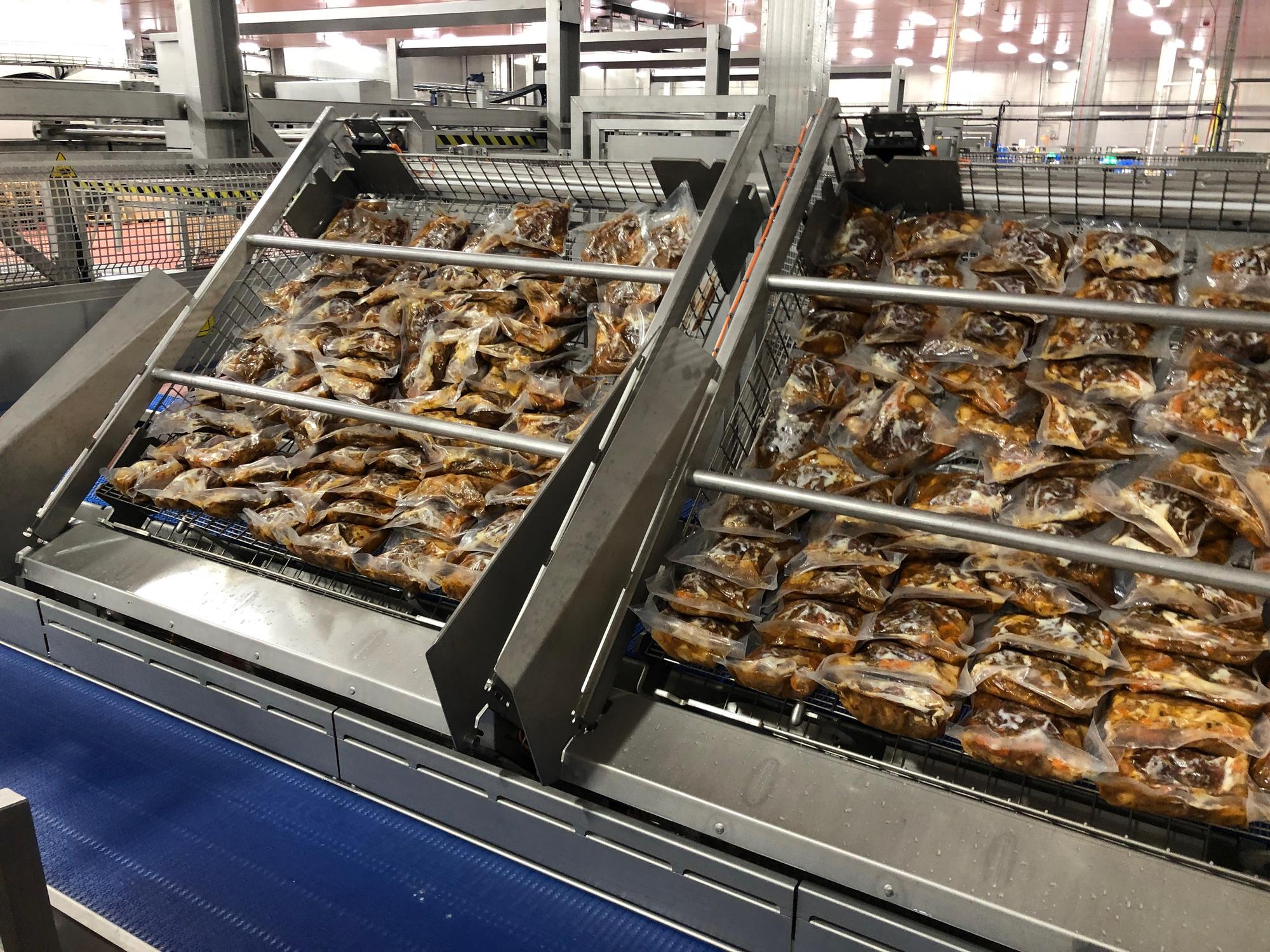
The schmears are made centrally. So are the bagels. The category knows what the press kit does not. Pre-shaped, shipped frozen, slacked at the store overnight, boiled and baked in front of the guest the next day. The shaping and the proofing that every traditional bagel shop does before sunrise happens once, at scale, at a central facility. The labor every other bagel shop carries, this one doesn't. The theater every guest came for, this one keeps. The guest sees a hot bagel and a line out the door. They do not need to see the rest.
That is the first discipline, and the rest of this essay is in service of it. Every concept that understood it lived. Every concept that got it backwards died, and several spent enormous amounts of money dying.
The graveyard
Between 2019 and 2024, roughly three billion dollars flowed into the purest expression of the efficiency idea: the ghost kitchen. Strip everything. No dining room. No servers. No host. No prime real estate. Just production in an industrial bay, fulfilling delivery orders. On a spreadsheet it was irresistible. Lower cost structure, higher margin, multiple brands from one kitchen.
Kitchen United ran the most sophisticated version of the bet. Backed by Kroger. Micro-kitchens kitted to each tenant's menu. Dry-storage lockers per stall. Chick-fil-A took multiple bays to centralize catering away from its dining rooms. A conveyor carried orders from the back of the house to the front, where delivery drivers checked in from the street. I walked the Chicago location before it opened in 2019 with an early hire who built it. I flew to their Pasadena HQ to meet the leadership team. The architecture was tight. In 2023 they announced they would sell or close every location. Sophistication did not save the bet.
The rest of the category followed. At one set of CloudKitchens facilities, 41 of 71 restaurants closed inside a year, a 58% failure rate. Berg Hospitality pulled its concept out of a CloudKitchens building after six months despite being the best-selling tenant in the place. Its founder's explanation was four words. The economics did not work. Wendy's abandoned its ghost-kitchen plan. Applebee's folded its virtual wings brand. Butler Hospitality, which ran ghost kitchens for hotels, shut down.
The ghost kitchen failed because it violated the first discipline completely. It did not strip the cost the guest never saw. It stripped the experience itself, the entire reason a person chooses one place over another, and kept only the food in a bag on a doorstep. Part Four of this series argued that the dining room emptied because most rooms had stopped doing the work of hospitality. The ghost kitchen was the logical end of that abandonment. A restaurant that did none of the work and admitted it. The guest did not follow.
The ghost kitchen stripped the experience and kept the food. The survivors stripped the production and kept the experience. Same word, efficiency. Opposite outcomes.
The technology has to disappear
The second discipline is harder to see, because it looks like a question about robots and is actually a question about identity.
Sweetgreen acquired Spyce in 2021. The MIT-founded robotic restaurant closed its dining rooms within months. The same robot moved behind Sweetgreen's counter and became the Infinite Kitchen. The numbers were real. More than 700 basis points of labor savings against comparable stores, roughly half the staff, and one location in Hingham that posted a 30% restaurant-level margin in its first full month. You have probably never thought of Sweetgreen as a robot restaurant, because the automation sat behind the counter and the brand never asked you to care about it. On the second discipline, the technology disappeared into the operation and Sweetgreen got the architecture right. The company is in trouble for other reasons. The next discipline gets to them.
Now the counterexample, and it is the most expensive lesson in the category. Kernel was built by Steve Ells, the founder of Chipotle, a man with as much credibility in unit economics as anyone alive. Kernel put a robotic arm at the center of a small-footprint, low-labor concept and called itself, in Ells's own words to the New York Times, the platform of the future. The robot was the story. Media coverage was about the robot. The food, by the company's own later admission, got overshadowed by the robot.
Within roughly a year, Ells pulled the robots out, added meat to a menu that had underperformed as vegan, renamed the concept Counter Service, and told the market the company now wanted to talk about technology a lot less. The president of the company put the lesson plainly. The combination of humans and automated systems is the magic, not one or the other, and fully automated is not scalable. The founder of Chipotle ran the experiment with every advantage and concluded the technology has to recede.
He was not alone in the graveyard. Zume burned close to half a billion dollars on robots cooking pizza in moving trucks before it collapsed. Eatsa automated the entire front of house and is gone. Spyce, built by MIT engineers, closed its restaurants in 2021. Sweetgreen had already bought the robot. Cafe X put robot baristas in three locations and shut them all. Every one of them made the same error. The technology was the identity, not the instrument.
That is the second discipline. Cava understood it precisely. It invested in Hyphen's automated makeline but deployed it on the back-of-house digital line, out of the guest's sight, to speed up delivery orders. The company's own framing, in its annual report, is that the purpose of the tools is not automation for its own sake but to remove friction so the team can focus on hospitality. Cava runs a 24.4% restaurant-level margin. The robot is real and you will never see it.
The Survival Map
Where the technology recedes and the experience holds, concepts survive.
SurvivedInstructive / mixedDied
Every point is a public outcome. Survival clusters where the technology is invisible and the experience is protected. Death clusters where the technology is the show and the experience is gone. The middle is where the instructive cases sit.
Sources: Cava FY2025 Annual Report and 10-Q (SEC); QSR Magazine, Fast Company, company earnings on Sweetgreen Infinite Kitchen (2025); US Chamber of Commerce CO, QSR Magazine on PopUp Bagels (2025-2026); Franchise Times, FSR Magazine on Taffer's Tavern (2019-2025); TheStreet, QSR Magazine on Lemonade (2025); Fast Company, QSR Magazine on Sweetgreen-Wonder transaction (2025); Restaurant Business Online, The Spoon, Food On Demand on Kernel (2025); Restaurant Business Online, Physics World on Zume, Eatsa, Spyce, Cafe X (2020-2026); CNN Business, Restaurant Business Online on ghost-kitchen collapse (2023-2026). Positions are directional, anchored in the audit, not precise.
The third discipline is the one that kills the operators who got the first two right.
Lemonade ran a sound idea. A bright, cafeteria-style California concept supplied by a central commissary and finished in the store, the model that lets you run a smaller kitchen with less labor in expensive real estate. On paper it was the same architecture as the survivors. The dine-in model failed. All 23 locations closed as of October 2025. The idea was right. The volume was not there to cover the central infrastructure the original model required.
The discipline is unforgiving and a restaurant consultant named it years ago. Centralized production is a financial model with a break-even, and if the volume is not there, you are not saving money, you are just moving the cost to another building. Dean Small of Synergy Restaurant Consultants said exactly that. You need the sales. Otherwise you have displaced the labor and the overhead, not eliminated them.
Sweetgreen is the harder case. The architecture was right. The third discipline is failing anyway. The company is down roughly 90% from IPO. $134M loss in fiscal 2025. Five consecutive quarters of declining same-store sales. In November 2025 they sold the Infinite Kitchen business to Wonder for $186M, agreeing to buy units back at cost plus five percent. The technology worked at the unit level. Owning the manufacturing was a different business, a drag on margin, projected savings from offloading it just over one percent of revenue. The operator who tries to also be the equipment company is straddling two businesses and doing neither well.
The larger lesson is that the third discipline is unforgiving even when the first two are met. Architecture right, trajectory down. Holding two disciplines does not save you from missing the third.
That is the third discipline.
The Three Disciplines
Each rule proves itself with a matched win and a matched failure.
Hold all three and the model survives. Break one and the model dies, often expensively.
01 · The cost
Strip the cost the guest never saw. Keep the experience they came for.
Got it right
PopUp Bagels
Cost stripped. Theater kept.
Got it wrong
Ghost kitchens
Cost stripped. Experience killed.
02 · The tech
The technology must serve the food and disappear. The moment it becomes the identity, it fails.
Got it right
Cava
Tech invisible.
Got it wrong
Kernel
Tech as identity.
03 · The volume
A volume-and-utilization equation, not a magic trick. Match production to demand. Buy the tech, do not build it.
Got it right
Cava
Volume clears the model.
Got it wrong
Lemonade
Volume never came.
· · ·
What I learned, from both ends of the layer
A note on specifics. Customer names, program identifiers, and internal acquisition language are generalized below. Those specifics belonged to my former employers and stay there. The structural argument and the witness behind it do not depend on them. What remains is the part of the story that is mine to tell.
I did not arrive at these disciplines from a spreadsheet. I arrived at them as an operator who worked both sides of the table.
Years before Castle Peak, I was inside Ruprecht, a sous-vide protein supplier, scaling new protein programs from concept to ten million in run rate. This was nearly a decade ago. Cuisine Solutions had only just developed the egg bite for Starbucks. Sous vide was still new at the commercial level.
The layer was already multi-channel and none of the channels delivered on its own. We won slots in the major national broadline distributor's annual cutting-edge product showcase and saw almost no volume follow. We sold chains directly. A national fast-casual burger chain whose chicken arrives sous-vide pre-cooked was one of the products we built, dredged in store and fried to finish. We worked the GPO side, building a fully-cooked sous-vide proteins program that ran through a major broadline distributor. None of it produced volume on its own.
Volume came from direct, strategic, key-account work compounded across channels, not delivered by any single one of them. The product the independent operator could have used the most rarely saw it on terms that worked. The layer was real. It was not built for the operator who needed it most, and no single channel was going to assemble it for them.
A few years later I was at Sodexo, leading food transformation across the company's North American portfolio. I evaluated the automated assembly technology the market now knows as the Infinite Kitchen, before Sweetgreen owned it. The mechanics were straightforward. Ingredients loaded into chambers above the line. Dispensed vertically into the bowl from the POS order. Liquids and sauces included. Salads and bowls were a no-brainer. Sandwiches, wraps, anything with touch points or composition? The model broke.
The use case I had in mind was the one Sweetgreen never built. Take the build line out of the store. Put it in a central production node. Feed it from a market, not a single unit. Concentrate the volume across multiple institutional segments. One machine, many sites. I made the case to buy it.
I looked at Hyphen for the same reason. Same solution, different vendor. Assembly model with vertical dispensers. The technology was sound at the bench. Hyphen had key partners on board, including a large fresh produce wholesale operator running exactly the kind of central production this category needs to prove. What Hyphen did not have yet was enough deployment proof for Sodexo to commit. Technical maturity was almost there. The reference base was not.
The deeper problem was on the buyer side of the table. The institutional channel is fragmented by structure. Segments and accounts often run their own menus and programs. The operational discipline and cross-segment cooperation needed to feed one shared production node from a portfolio of accounts is, in practice, heavier than the equipment itself. Operationally simple. Organizationally impossible at the scale that would have made the model run.
The conclusion I reached then is the one I would stake this essay on now. The leverage was never in a single store, where the machine sits idle between rushes and earns its keep only a few hours a day. It was in feeding the machine from a market. Sweetgreen put the machine in the store and sold it three years later. Cava put automation on the back line and kept operating. Retail deployment of the assembly machine does not yield the efficiency of the model at current operating economics. The economic case requires more volume than a focused menu in a single location can clear, and the math holds until labor or occupancy costs shift enough to invert it.
That is the insight underneath all three disciplines, and it is the same insight from either side of the table. The pieces to refuse the inherited restaurant already exist. They are scattered across different companies and different segments. The ventless oven in one corner. The sous-vide protein in another. The automated line somewhere else. From the supplier side at Ruprecht, I watched product reach only a fraction of the operators who could have used it. The channels were real. None of them assembled the demand for an operator who could not assemble it alone. From the buyer side at Sodexo, I watched the technology come within reach and the institution fail to align around it. The work is not invention. The work is assembly, on terms the operator can actually meet, by an integrator the existing layer was never built to be. The chef opening her ramen counter on a Tuesday is the operator the existing layer was never built to serve. The integrator she needs has not yet been built.
The same lever, every tier
This is not a single segment's story. The same levers play across the market, weighted differently depending on what the guest came for. At the smallest scale, PopUp Bagels strips the menu to one product and engineers the labor out while keeping the theater. At fast-casual, Cava holds a tight menu and deploys automation invisibly on the back line, with more than 17 billion possible combinations built from a deliberately small set of ingredients. Wonder put a ventless oven in every unit and made real estate almost unconstrained. Its founder said the kitchen could go in a shoe store.
The ventless oven is the most underrated lever in the building. David Shave, Middleby's head of global sales, has been asking operators the obvious question for years: why spend twenty thousand dollars on a ventilation system that generates zero revenue? But twenty thousand understates the line. The hood is the smallest piece. The legacy build adds black iron for the gas, an exhaust shaft running from hood to roof, makeup air, a grease trap, fire suppression, the Type I permit, and a code review cycle that takes months. The bill commonly clears two hundred thousand dollars before the first ticket prints. Remove the requirement and the whole real-estate equation changes. Smaller spaces, cheaper buildouts, locations the legacy build could never reach become options. It is not a gadget. It is a key that unlocks the single largest fixed constraint on where a restaurant can exist.
The full-service question
The Cheesecake Factory scratch-makes its enormous menu in house. Almost no guest knows. They walk out happy.
Jon Taffer made his name fixing other people's restaurants. Bar Rescue ran for ten seasons. More than two hundred bars built by other people, failing, fixed in two days on camera. Then he built his own concept on exactly the architecture this essay describes. No hood. No traditional oven. Sous-vide proteins from Cuisine Solutions, finished in combi ovens. A kitchen that needs two or three cooks instead of six to eight. A claimed 50 to 60 percent reduction in labor. The execution has been hard. A Massachusetts location closed in 2024. Six years after launch the open footprint is small against the 22-plus units once announced, and in 2025 the brand handed its growth to a platform operator.
Framing check. Taffer is deliberately not used here to prove full-service works or fails. The struggles are confounded by celebrity, brand, and franchisee factors that have nothing to do with whether ventless sous-vide can power a tavern. He is used only to show the model is sound and that a sound model is not a guarantee.
What Taffer's struggle proves is narrow. A sound operating model is necessary but not sufficient. Brand, execution, and operator quality still decide the outcome. Full service is harder, the experience you must protect is richer and longer, and nobody has yet executed it cleanly enough in public to settle the question. In a market this large, that is white space.
Interactive Tool
Build the next survivor.
The disciplines this essay names live as six levers in the sandbox: supply, menu, equipment, production location, in-store experience, daily volume. Pull them. Watch your concept move across the survival map alongside twenty real outcomes. The map is what got built. The disciplines are what gets built next. Click any case to see why it survived or died. No lever is free.
Every concept in this essay had something the ordinary operator does not. PopUp Bagels raised forty million dollars. Sweetgreen and Cava are public companies. Taffer has a celebrity brand, a franchise machine, and a relationship with the largest sous-vide manufacturer in the world. The ventless ovens, the automated lines, the central commissaries, all of it takes capital or volume density or both. The operator running one or three locations will never assemble that alone.
If the model that survives is reachable only by the capitalized few, this essay has written a more sophisticated version of the same story the first five told. The advantage flows to scale. The independent gets squeezed out, this time by an operating model instead of a platform. The ventless revolution becomes the supply-side version of the DoorDash story. New efficiency, same concentration of who captures it.
That is the pessimist's reading. It is the honest one if nothing changes. But the structural answer is closer to existing than most operators realize. The pieces of the shared production layer are already built. They sit in different channels, each shaped for the customer it was built for. Cuisine Solutions, the largest sous-vide manufacturer in the country, sells into hotels, airlines, and the military at contract scale and contract terms the single-unit operator will never see. Their pricing is premium. They sell to enterprises. Broadline meat processors are a separate channel. They push sous-vide proteins through Sysco and US Foods at distributor margins that compress what is left for the independent. No one has built the integrated layer for the operator who runs one or three units. The layer the survivors use is real. The version the rest of the market needs is not yet on the shelf.
The question is not whether the small operator can build a commissary. They cannot. It is who builds the integrated layer that lets a thousand independents finish and serve without owning the kitchen, on economics the operator can actually survive on. And the entity positioned to build that layer, to aggregate the production and distribute it across a fragmented market, is the institutional channel itself. The distributors. The group purchasing organizations. The contract operators who already sit between most suppliers and most operators.
The next and final essay takes this up. The same consolidation that looks like a threat in the platform story is the delivery mechanism in the production story, if the independents can plug into it instead of being squeezed by it. The model that survives is real. Today it is concentrated. The path to widening it runs through the layer that already touches everyone.
Five years from now the ramen counter has nine locations. She still runs three people to a shift. Proteins arrive finished. Broth is built on Tuesdays at a shared production node that serves her and twenty other independents. The kitchen runs on a ventless combi and a six-burner induction. The dining room is full because she put what she saved on equipment into the room. None of this took a public offering. None of it took forty million dollars. The layer she plugged into is the answer to the question this essay asked.
The inherited restaurant was a list of decisions someone else made. They were never laws. They were habits. Habits can be refused. The operators who treat them as questions are building the answer.
The operators refusing the inherited list are writing the next chapter. They are doing it on terms the legacy taught no one. The work of widening the layer is bigger than any one operator. If you have started, find us. If you are about to, find us sooner.
The next chapter gets written by the ones who have already started.
What gets built instead?
What the few are already building. What everyone else has to build next.
Twenty-five years across food and hospitality, on every side of the chain. Ran a Chicago agency from 2009 to 2013 working with the chef-driven rooms of the local-sourcing era and watched what happened to most of them. Supplier-side and operator-side both, from the corner room to institutional scale. Castle Peak Ventures works the connection.