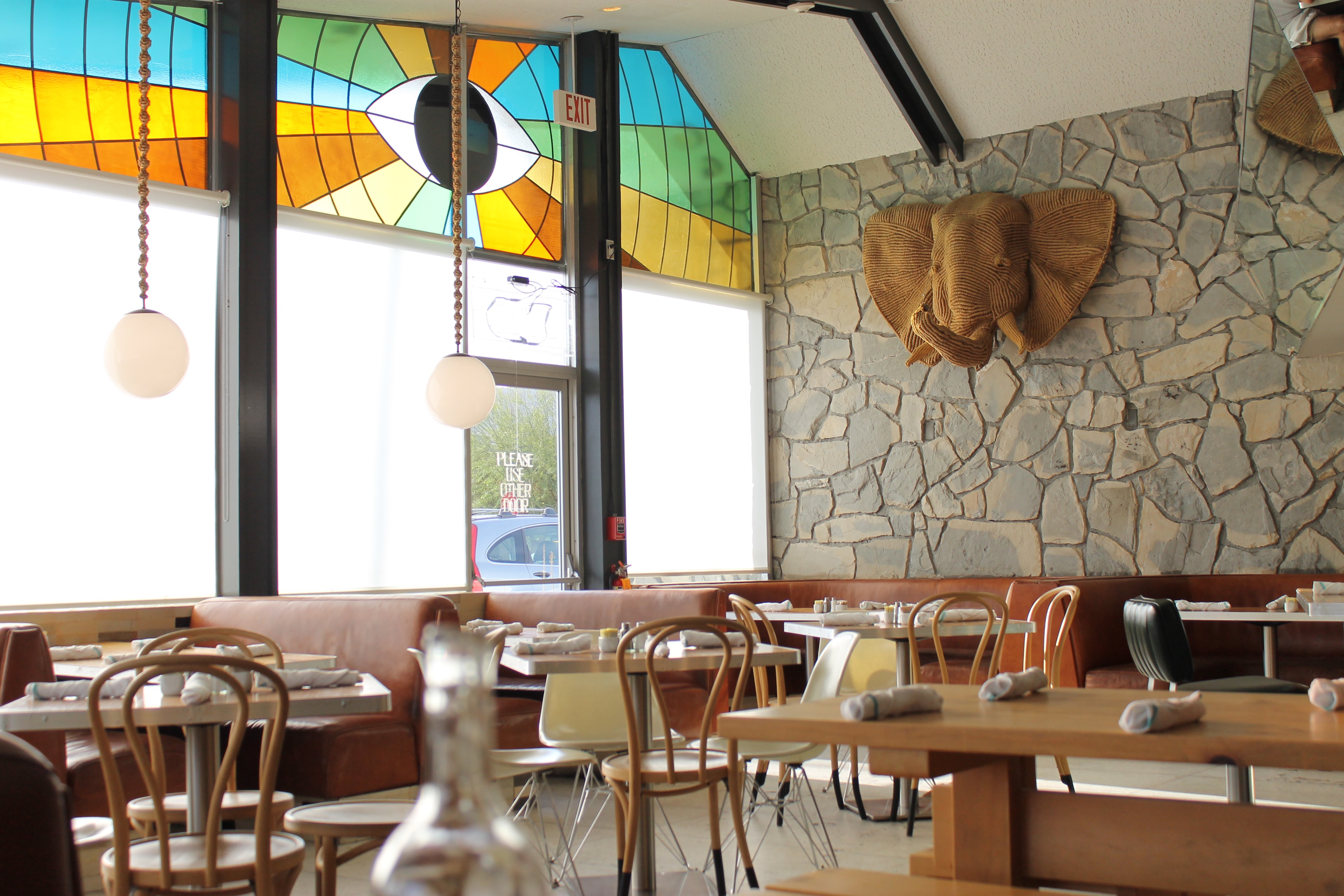
© Johnny Auer · King's Highway, Ace Hotel Palm Springs
She had no restaurant. Yet. But on this idyllic Chicago summer evening in 2009, across three stations with wine and beer flowing, a Top Chef champion was working flat out to give the first tease at the restaurant that was coming. She called in friends. Lee Ann Wong worked beside her assembling plate after plate. And she had a Twitter account; one that sold a hundred tickets to this event in minutes. It was the Wandering Goat. The first one. The chef was Stephanie Izard. And I was there.
They worked the line in brown tees with stains down the front, hours of prep on their faces. When they were not on the line, they were walking the yard. Refilling beers before they hit empty. Changing conversations before they got awkward. Strangers who did not know each other found themselves in circles by the third course. Some left with friends.
The room that night had no infrastructure. No reservation. No app. No four walls. When operators say "the room," they mean the experience, not the architecture. Stephanie had no architecture. The discipline was the room. That is what the room used to do.
Nearly seventeen years later, the room is emptying. The dining rooms reopened after the pandemic. Many of the customers didn't come back as often. The industry is thriving anyway. Spending is up. Traffic is down. The money flows through. The people don't show up like they used to.
This is not a story about restaurants dying. The industry is bigger, by revenue, than it has ever been. What's missing is the room.
Americans are spending more on food away from home than at any point in history. And yet industry traffic declined for 11 consecutive months. The industry succeeded at something it never intended. It taught 330 million people that restaurant food doesn't require a restaurant.
The trend is older than delivery apps. It is older than the internet. Americans have been shifting their food spending from the kitchen to the restaurant for six decades.
In 1997, Americans spent $336 billion on food away from home. By 2024, that number was $1.54 trillion. Food delivery spending alone went from $9.8 billion to over $100 billion in the same period. A 924% increase. Even adjusted for inflation, the growth has outpaced food at home by a factor of nearly two.
The share of food dollars going to restaurants, fast food, and delivery has gone in one direction for sixty years, with only two interruptions: the Great Recession in 2008 and the pandemic in 2020. Both times, the rebound was faster and stronger than the dip.
The industry is not shrinking. It is structurally, permanently larger than it was a generation ago. What's shrinking is the part that happens in the room.
Nearly three out of four orders placed at a restaurant are consumed somewhere else. Not at a table. Not in the room. Not in the presence of the people who made the food. The restaurant made the meal. Somebody else delivered it. The customer ate it on a couch, at a desk, or standing in a kitchen scrolling through their phone.
The money came in. The customer didn't.
To understand what was lost, you have to understand what the room was for.
In 2006, Danny Meyer published Setting the Table and gave the restaurant industry a philosophy it had been practicing without naming. He called it Enlightened Hospitality. Service is what you do for someone. Hospitality is how you make them feel. Service is delivering the right plate to the right seat. Hospitality is making the person in that seat feel like someone is on their side.
Meyer built Union Square Cafe, Gramercy Tavern, Eleven Madison Park, Blue Smoke, The Modern, and Shake Shack on that distinction. Not on the food alone. On the feeling. The restaurants succeeded because the room delivered something beyond the plate. The experience of being taken care of by people who were genuinely glad you showed up.
Will Guidara, who took Eleven Madison Park from a struggling brasserie to the best restaurant in the world, pushed the philosophy further. "Service is black and white," he wrote in Unreasonable Hospitality. "Hospitality is color." His team bought sleds and took a family to Central Park after they mentioned they'd never seen snow. They bought a hot dog from a street cart and plated it on fine china for tourists who regretted missing the experience. They fed customers' parking meters so the meal wouldn't be interrupted. His rule. Manage 95% of the business down to the penny. Spend 5% foolishly on moments that have outsized impact on how people feel.
Stephanie was running this discipline in a backyard in 2009. Meyer's book was three years old. Guidara had not written his yet. The practice predates the books.
That was what the room was for. Not just eating. Not just service. The room was the delivery mechanism for a philosophy that says the way you make people feel matters as much as the product you serve. The heat from the kitchen. The attention of the server. The arrangement of the plate. The timing of the courses. The ambient noise of other people enjoying the same thing you were enjoying. All of it came together into something that justified the price and the effort.
None of that fits in a bag.
The room is human technology. It takes a hundred people who do not know each other and turns them, for an evening, into something close to a neighborhood.
Ray Oldenburg called it the third place in 1989. Home is first. Work is second. The third is where strangers in the same zip code share an unstructured public moment. The library is shrinking. The mall is gone. The church is going. The neighborhood bar held on longer than most. Restaurants are the most common third place left in American life. Closing the rooms is not just closing restaurants. It is closing one of the last places strangers gather over something other than work or screens. Robert Putnam's Bowling Alone mapped the civic decline of the last three decades. The room emptying is part of that map. It is one of the last institutions still holding.
That is what was happening in Stephanie's backyard. Strangers in circles by the third course. People who walked in alone left with friends. The room set the conditions. The chef ran the conditions. None of that happens on a couch. None of it survives a bag.
The room also dignifies the work. The line cook plating dinner is performing a craft. The server reading a table is exercising a discipline that takes years to develop. The bag does not call for any of that. The bag calls for speed and accuracy. The work the bag rewards is the work the bag can replace.
The room is also memory. People remember meals that happened in rooms. They forget the meals that arrived in plastic.
The history is short. Seamless in 1999. Grubhub in 2004. DoorDash in 2013. Uber Eats in 2014. In barely a decade, a new category of company inserted itself between the restaurant and the customer. Most of the delivery companies were funded by venture capital, which meant they were obligated to grow as fast as possible. To do that, they subsidized the cost. Cheap delivery for consumers. Decent rates for restaurants. Silicon Valley covered the difference.
Then came 2020. Eating restaurant food at home went from an indulgence to a necessity. Restaurants that had never considered delivery started offering it because they had no choice. Delivery app sales more than doubled from April 2019 to April 2020. The habit formed. The pandemic ended. The habit didn't.
Convenience works like a ratchet. Once the consumer understood that any food they wanted could arrive at their door, they expected it. The dining rooms reopened. Many of the customers didn't come back.
The bag is one thread inside a bigger system. Menu inflation up roughly thirty percent since 2020. Work-from-home reshaping the weekday lunch economy. Suburban migration moving customers away from the urban rooms they used to fill. Tipping fatigue, parking costs, childcare costs, declining alcohol consumption, generational habit shifts. The room emptying is one symptom on a wider chart. The bag did not work alone.
Delivery did real things. For the operator on a side street with no foot traffic, the platform offered customers the operator could not have found alone. For the working parent with two kids, takeout meant a hot meal at home on a night that would have been cereal. For the chain with a thin location strategy, off-premise extended margin to revenue that could not have been recovered any other way. The bag has been a lifeline for some operators and some lives. The argument is not that the bag should not exist. The argument is that most of the rooms it competed with had stopped justifying the trip.
In October 2025, Ellen Cushing wrote in The Atlantic about what was happening culturally. She profiled Shannon Orr, a twenty-year hospitality veteran who told her she didn't know what hospitality meant anymore. Orr's exact line: "I'm a restaurateur. And now I don't want to open a huge restaurant. I want to open a bar with five tables and a huge takeout window." Cushing also quoted Collin Wallace, a former Grubhub executive who walked away from the platform business. His description of what it became: "A zero-sum game where you're basically just selling weapons to both sides, but no one's actually better off, because it turns out there's only so much stomach space to go around." Wallace says he rarely orders delivery anymore. Cushing's reporting captured the cultural toll in devastating detail. The economic data made the cultural loss starker.
Some of those rooms deserved to lose. Many had stopped doing the work long before the bag arrived. The operators who built rooms as stages rather than rooms as discipline gave the bag its opening. The customer who chose convenience was often choosing against a room that had become inconsistent, indifferent, or expensive without proportional return. Operator complicity is part of the story. The bag did not steal the customer. It accepted the customer the room had stopped earning.
The delivery boom didn't just move customers out of the dining room. It changed every part of the operation that stayed behind.
The ghost kitchen was the logical endpoint. A restaurant without a room. A kitchen that produces food for delivery and nothing else. At the peak of the boom, ghost kitchens were projected to make up 20%+ of the industry. Companies raised hundreds of millions. Then they started closing. Kitchen United, which raised $175 million from investors including Kroger, shut down all locations in November 2023. 70% of consumers said their food should come from a real, physical location. The room, it turns out, is the brand. Without it, you're selling a commodity.
The hundred who walked through that side gate in 2009 are on couches tonight. The room is set for forty. Twelve tables will not seat. The bartender polished the glasses two hours ago. The line watches the printer for the next bag at the back door. The room is full of preparation. It is not full of people.
More people say they prefer dining out than at any point since the pandemic. 90% say they enjoy going to restaurants. And yet 75% of orders happen off-premise. 46% of operators reported lower traffic year-over-year in March 2026. The customers say they want the room. Then they order through the app.
The macro is 46% of operators reporting a drop. The micro is the server who lost two shifts this week, the cook whose hours got cut at nine, the host who cleared half the room and went home. The bag takes the trip. The labor that was supposed to fill the room takes the loss.
This isn't hypocrisy. It's the gap between what people value and what they do. Convenience wins the daily decision even when the consumer knows the experience is better in person. The restaurant competes with the couch. The couch wins on commitment. No reservation. No parking. No social performance. The bag shows up while the customer is in sweatpants.
Some operators still draw the room. Two categories.
The first is mainstream casual. Chili's same-store sales jumped 31% in the quarter ending December 2024, with traffic up nearly 20%. The CEO credited social media. "They're like, 'Wow, this experience is really good,' and it becomes part of the rotation." Texas Roadhouse posted double-digit sales increases in 2024. Hand-cut steaks. Fresh-baked bread. Peanut shells on the floor. The customer felt like they got more than they paid for.
Mainstream is winning on two things at once. Value pricing relative to fast casual, and experience the kitchen alone cannot deliver. Brinker has aggressive marketing and competitive prices that outflank fast casual. Texas Roadhouse offers a steakhouse experience at near-fast-casual prices. Then both reinvest in the room. Music. Lights. Bartender visibility. Staff energy. The customer walks in and the place is loud. The bread is hot. The server is named. The price is clear. The discipline is on every Thursday, not just the nights the press is in. The customer feels they got more than they paid for. That feeling is the product.
The second is the chef-driven independent. The Meyer-trained alums. The neighborhood place where the chef walks the floor and the manager remembers your name. The Wandering Goat in 2009 was that. Strangers in circles by the third course. A plate seventeen years later still on someone's tongue. That category is smaller. The discipline is harder. The economics are tighter. When it shows up, it produces an experience the bag cannot reach.
Both categories work for the same reason. They are running the room as the product, not as the wrapper. The mainstream does it through scale and consistency. The chef-driven does it through discipline and presence. The bag is not the answer. The room is.
Gen Z is the signal. The generation that prefers delivery 69% to 31% is also showing up for full-service experiences they perceive as worth it. They show up when the room gives them a reason. They show up for the mainstream when it is loud and warm. They show up for the chef-driven when the discipline is on. They do not show up when the room is the show.
What was lost is the thing Meyer named and Guidara built a career proving. That a restaurant exists to make people feel something. That hospitality is the product. The plate is the proof. The industry figured out how to grow revenue without the room. It did not figure out how to grow without losing what made it matter.
But the room had been losing it longer than the data shows.
Hospitality is a relationship. Service is a transaction. The bag is the cleanest transaction of all.
For two decades, the industry chased two waves. The celebrity chef. The design-driven space behind it. Chef partners. Architects. Lighting consultants. Press release moments. Rooms designed to perform on Instagram, to land in the lists, to draw the press visit. Hospitality as the vocabulary. The room as the show. The customer paid for an elevated transaction. Same machinery underneath. Better lighting on top.
Meyer built the other thing. The salt placed where the regular reaches. The chit that says she only orders Sancerre. The pre-shift lineup where every server gets the night's reservations annotated with what each guest needs. The OpenTable guest notes his restaurants have used since 1998 to track every preference and occasion. The discipline is invisible. The room is incidental. The system has been documented in plain sight for thirty years. Meyer wrote it down in Setting the Table in 2006. The industry could have copied it. Most of it didn't.
The customers who left were not abandoning hospitality. They were abandoning the performance of it. The bag delivers food adequately. It cannot deliver a room. It also cannot fail to deliver hospitality if the room was never delivering hospitality to begin with. The trade was never about the discipline. It was about the show. The show transfers poorly to a couch.
A $16 burger in a cardboard box reads as a rip-off. The same burger at a table, with a server who is paying attention, in a room run on the discipline, reads as a fair deal. We have not changed the food. We have removed the show. The price stayed the same.
Nearly seventeen years after that backyard, Stephanie still cooks. She is one of seven chef partners at Boka Restaurant Group. Twenty-four restaurants across Chicago, Los Angeles, and New York. Three Michelin-starred. A quarter-billion in annual revenue. The opposite end of the spectrum from a Twitter account and a friend's backyard.
The bet is being tested at this tier too. Fine dining same-store traffic fell 2.9% from July through September 2025. Guest sentiment in fine dining is declining. The only segment where it is. The reservation gets cancelled within twenty-four hours. The repeat visit does not repeat. The anniversary dinner moves home. The customer paying premium is the customer most attuned to whether the room is delivering what the price is asking. The room had been the gold standard for the discipline. Sentiment declining at fine dining is the discipline failing at the tier built around it.
Different mechanism than the bag. Same direction. The industry has been quietly selecting for visibility over discipline at every tier for two decades. The bag exposed the gap at the casual tier. Trade-down is exposing it at fine dining. The crisis is one crisis with different symptoms by tier.
The future is not dine-in versus delivery. It is earned presence versus default convenience.
The room is not dead. 90% of adults still say they enjoy going to restaurants. Chili's is packed because the room runs hot. Texas Roadhouse has a wait because the discipline is on every Thursday, not just the nights the press is in. Gen Z is showing up for full-service experiences they perceive as worth the trip. The room works when it earns the visit. It does not work when it is the show.
The next part of this series goes to the consumer. To the gap between what we paid for and what we got, between what we tell ourselves and what is true.
The customer who paid for the room and got the bag is the customer who decided.
What happened to the room?
We left.